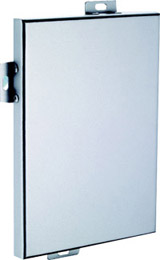
 Since the birth of aluminum from SBC, by virtue of their superior weatherability, corrosion resistance, swept the world in a relatively short time has become a large-scale indoor and outdoor decoration of the new construction to build environmentally-friendly materials, it is widely used in external walls, interior. Its superior environmental performance and plasticity can not be replaced by other materials, and therefore sought after by architectural designers... Since the birth of aluminum from SBC, by virtue of their superior weatherability, corrosion resistance, swept the world in a relatively short time has become a large-scale indoor and outdoor decoration of the new construction to build environmentally-friendly materials, it is widely used in external walls, interior. Its superior environmental performance and plasticity can not be replaced by other materials, and therefore sought after by architectural designers...
Aluminum veneer is a kind of deeply processing series product in today's construction product. It has a lot of advantages, like light weight, high strength, corrosion resistance and corruption resistance and so on. Its complex processing technology enable it to be processed into plate shape, arc shape and spherical shape
and other complicated shapes; not just a kind of color can be selected, so the decoration effect is satisfying, excellent pollution resistant makes it easy to clean and amend. It is not only very convenient to Install and can be recycled, but also harmonious to environmental protection. This product can be applied to decorating
building's wall, beam, balcony, separate wall, indoor decoration, etc,which is popular.
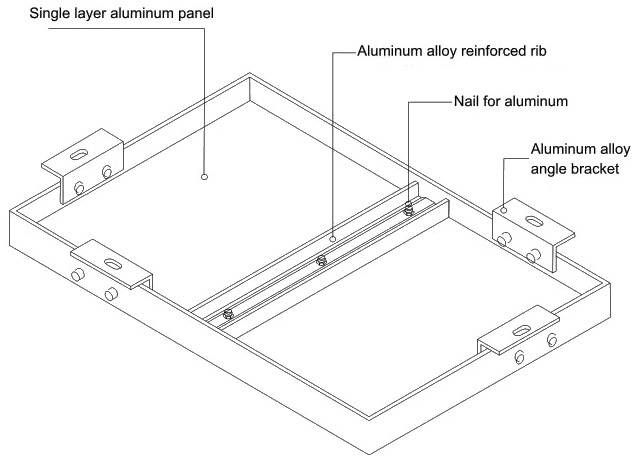
All the single-layer aluminum curtain walls produced by our company used high-quality and high-strength aluminum alloy material to process. Its thickness: 2.0 mm, often 2.5 mm, 3.0 mm, 3.5 mm, 4.0 mm. the structure of processed aluminum curtain wall plate consists mainly of panel, reinforcement, hanging ear etc. if you love, the back of the plate can be filled with a insulation layer of cotton, and hang ears can be directly made by the panel, as well as added . the back of the plates can be weld with bolts, and through welding bolts, the reinforcement and panel combines firmly to be a stable combination, and reinforcements improve the strength of the plate, guaranteeing the anti-winded and flat function of the plates when being long time used.
Aluminum veneer's material and structures

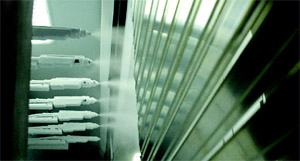 The pudf principles of fluorine carbon resin The pudf principles of fluorine carbon resin
the fluorine resin PVDF used on the product is the polyethylene pyrrolidone ,which was made by using the fluorine atom to take place of some hydrogen atoms. (Polyvinyl Pyrrolidone) The combination power of fluorine (F) atoms and carbon (C) atoms is higher than 105.4kcal/mol, that means to destroy the F-C combination need at least one 105.4kcal/mol energy. The distance of F-C Combination is 1.36A which is shorter than the distance of C-C combination
1.54A. Because of the solid block caused by F-atom which makes the structure strong enough, it is hard to destroy the combination of a carbon-fluorine.
HYLAR5000 is the trademarks of PVDF resin that registered by AUSIMONT USA Company.
HYLAR5000 is the trademarks of PVDF resin that registered by Atochem North America
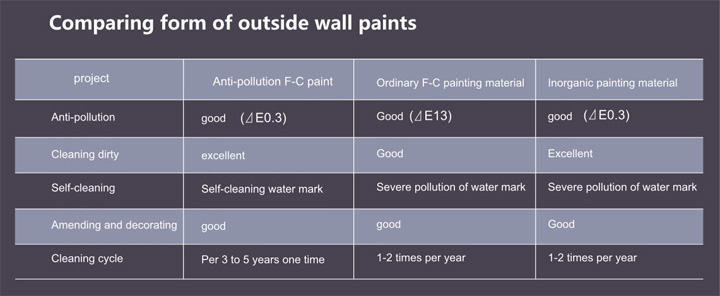
 Peculiarities Peculiarities
-
The combination of PVDF resin and inorganic pigments enables it durable more than 20 years.
-
Equiped with a powerful combination of F-C excellent durability and wear resistance.
-
Excellent surface properties and stable chemical properties make the F-C paint's resistance better
-
Its specially low water-corroding makes an excellent ability of corroding-bearable.
-
Through heating reaction, it has an excellent adhesion.
-
It can meet all the colors the modern architecture required.
-
The unfixing off-coating makes it easily keeping and amending.
Fluorocarbon aluminum veneer
The base material of aluminum alloy external wall panel is imported A3003 aluminum-manganese alloy series or A5052 aluminum-magnesium alloy series quality plate, therefore, the aluminum panel has better tensile strength, yield (distortion) strength compared with other kinds of aluminum panels.
Performance

Principle of fluorocarbon resin pvdf
Fluorocarbon resin PVDF which is applied for products is the Polyvinyl Pyrrolidone whose hydrogen atoms are substituted with fluorine atoms in the aliphatic carbon-hydrogen molecule structure The Fluorine-Carbon combination force between F and C which have max negative charge exceeds 105.4kcal/mol, which means that it requires at least 105.4kcal/mol energy for destroy F-C structure.
The F-C binding distance is 1.36A which is shorten than C-C binding distance which is 1.54A. Since F atom generates dimensional obstacle, the structure is very dense, therefore, it is very difficult to destroy the binding of F-C. HYLAR5000 is the trade mark of PVDF resin registered by AUSIMONT America.
KYNAR500 is the trade mark of PVDF resin registered by Atochem Norty America.
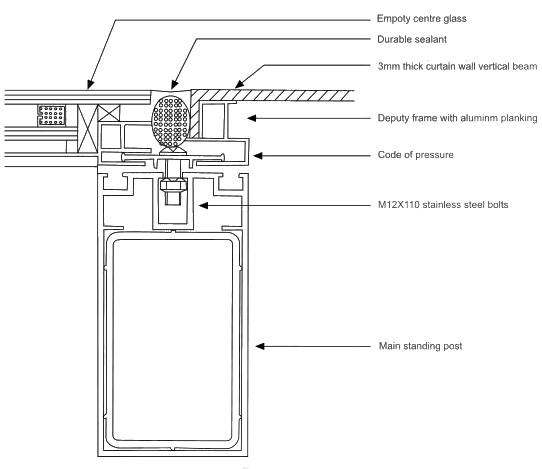
Aluminum curtain wall veneer and phase diagram of the node
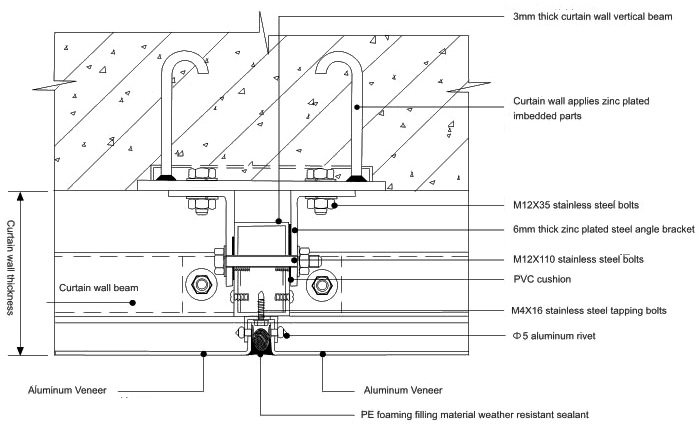
Aluminum and glass curtain wall veneer phase diagram of the node
|



 E-mail:



 Products





 Your position:
